Law Firm Marketing: The Mistake Costing You Real Cases
Most law firm marketing advice is built on a false premise. It assumes your problem is that not enough people are calling.
For most solo and small firms, that is not the problem. The phone is already ringing. The problem is what happens next.
A prospective client calls at 9pm on a Saturday after a car accident. Nobody answers. They call the next firm on the list. That case is gone, and no amount of ad spend gets it back.
This article is about the part of marketing for law firms that almost nobody talks about: the handoff between a marketing dollar and a signed case. We will look at what a real Gainesville attorney did about it, what it cost him, and how you can measure whether your own marketing is leaking cases the same way.
The real bottleneck in law firm marketing
Here is the sequence every law firm marketing dollar has to survive:
- Someone searches for an attorney
- They find your firm
- They call or submit a form
- Someone answers, qualifies them, and books a consultation
- They show up
- You sign the case
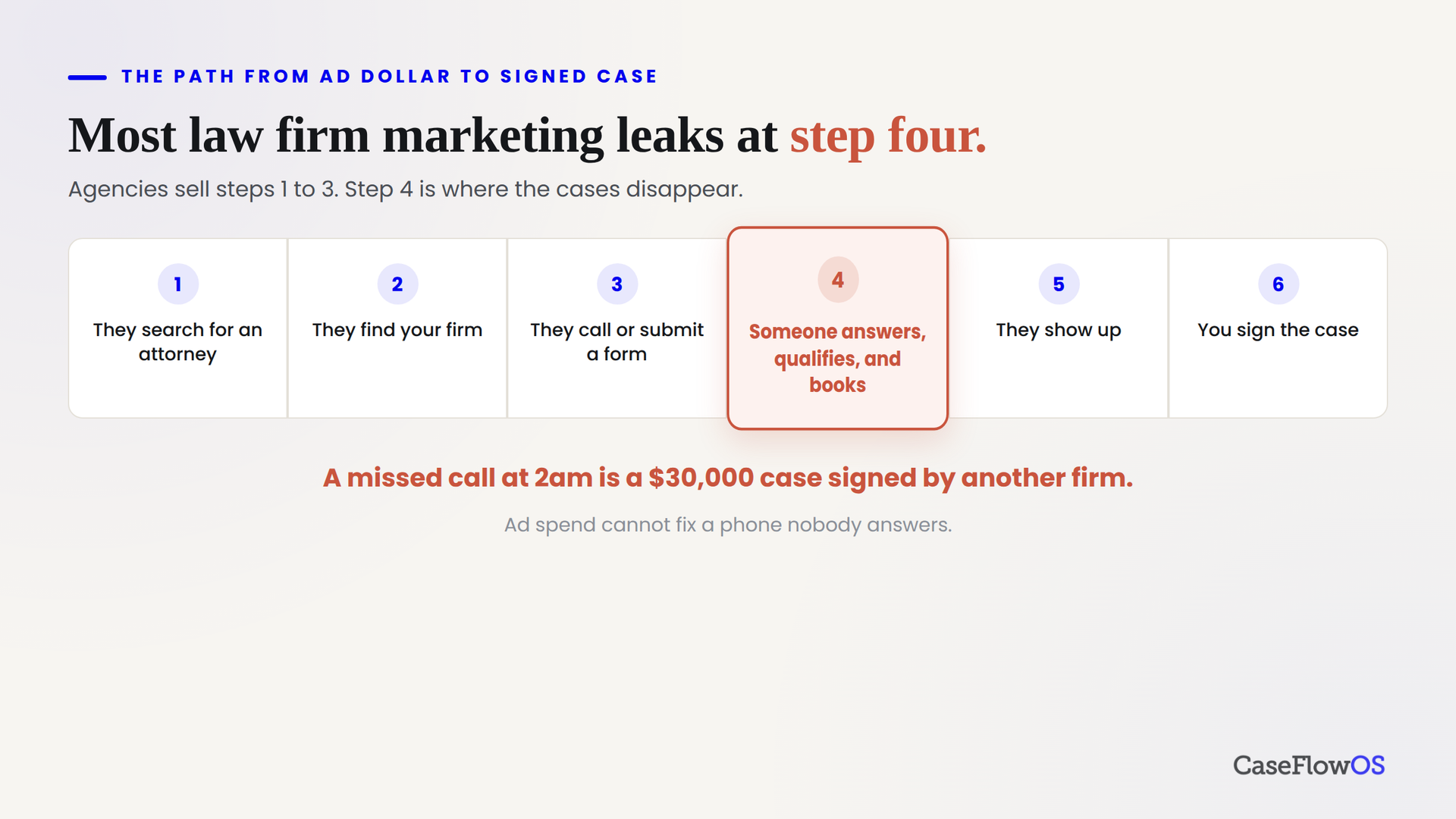
Steps 1 through 3 are what most marketing agencies sell. SEO, ads, content, websites. All of it aims at getting the phone to ring.
Step 4 is where the money actually leaks. And step 4 is almost never part of the marketing engagement.
Consider what a missed call is actually worth. The average personal injury case runs $30,000 to $300,000 in contingency. A criminal defense retainer runs $5,000 to $25,000. A family law matter runs $5,000 to $15,000.
Now consider when legal emergencies happen. DUI arrests happen at 2am. Accident victims call from the emergency room on a Saturday night. Custody crises happen on weekends. A large share of legal inquiries arrive outside business hours, when no one is at the desk.
If you spend $4,000 a month on law firm advertising and half your qualified callers reach a voicemail, you did not buy marketing. You bought a very expensive way to send prospects to your competitors.
A real example: what changed for Hutson Law Firm
Ben Hutson runs a criminal defense and personal injury practice in Gainesville, Florida. He is also a certified mediator. He runs a deliberately specialized, low-volume firm, taking a limited number of clients so he can give each one real attention.
For about ten years, a single assistant handled all of his client intake. She answered the calls, screened the callers, and put appointments on his calendar.
Then she left for another firm.
That moment forced a decision most small-firm attorneys will face eventually. In his words: "It really gave me an opportunity to reset at that point and think, how do I want to do this? Do I want to try to bring in somebody who is trying to do the job of the other person, or did I want to take advantage of some of the nice technology that's out there today?"
He had tried the traditional route before. He had hired a marketing company for SEO and advertising, and found it expensive, especially if the goal was competing head-on with the biggest firms in the market. That was never his goal. He wanted a steady flow of clients who were a genuine fit for his practice.
So instead of hiring and training a replacement, he installed an AI intake system.
What the system actually does
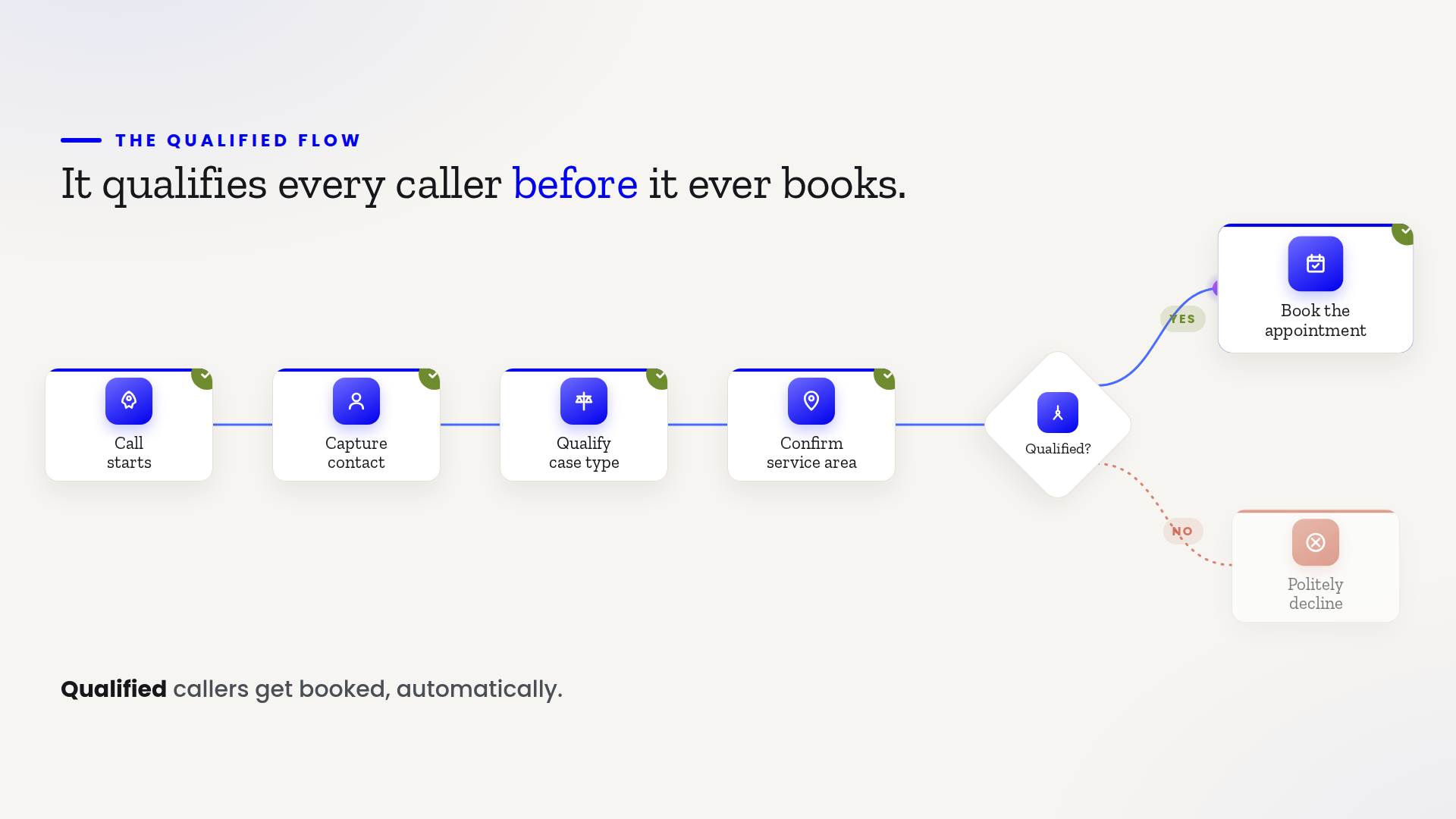
The system answers his calls, screens the caller, and qualifies them against his real criteria before anything reaches him. Is the matter in one of his practice areas? Is it in a county he is willing to travel to? Is the caller a realistic fit for his firm?
If the answer is yes, it books the consultation directly on his calendar. As Ben describes it: "It takes their calls. It communicates with these people in a professional fashion. It qualifies them to make sure it's a case that I'm going to want to talk to them about, and it actually sets the appointment for me and puts it on my calendar. It's a start-to-finish type of application."
The part that surprised him most was speed: "How quickly it came online, and how quickly I was able to see phone calls that I personally would never take turn into an appointment on my calendar. I was wowed by that."
The mountain
The moment it clicked for him happened on a hiking trip in South Carolina with his son.
He was on a mountain. He checked in on the system, the way he does from time to time, to see what had come in.
The system had already qualified a caller and booked an appointment for a case that was a perfect fit for his firm. He called the client on the way down the mountain and was retained on the spot.
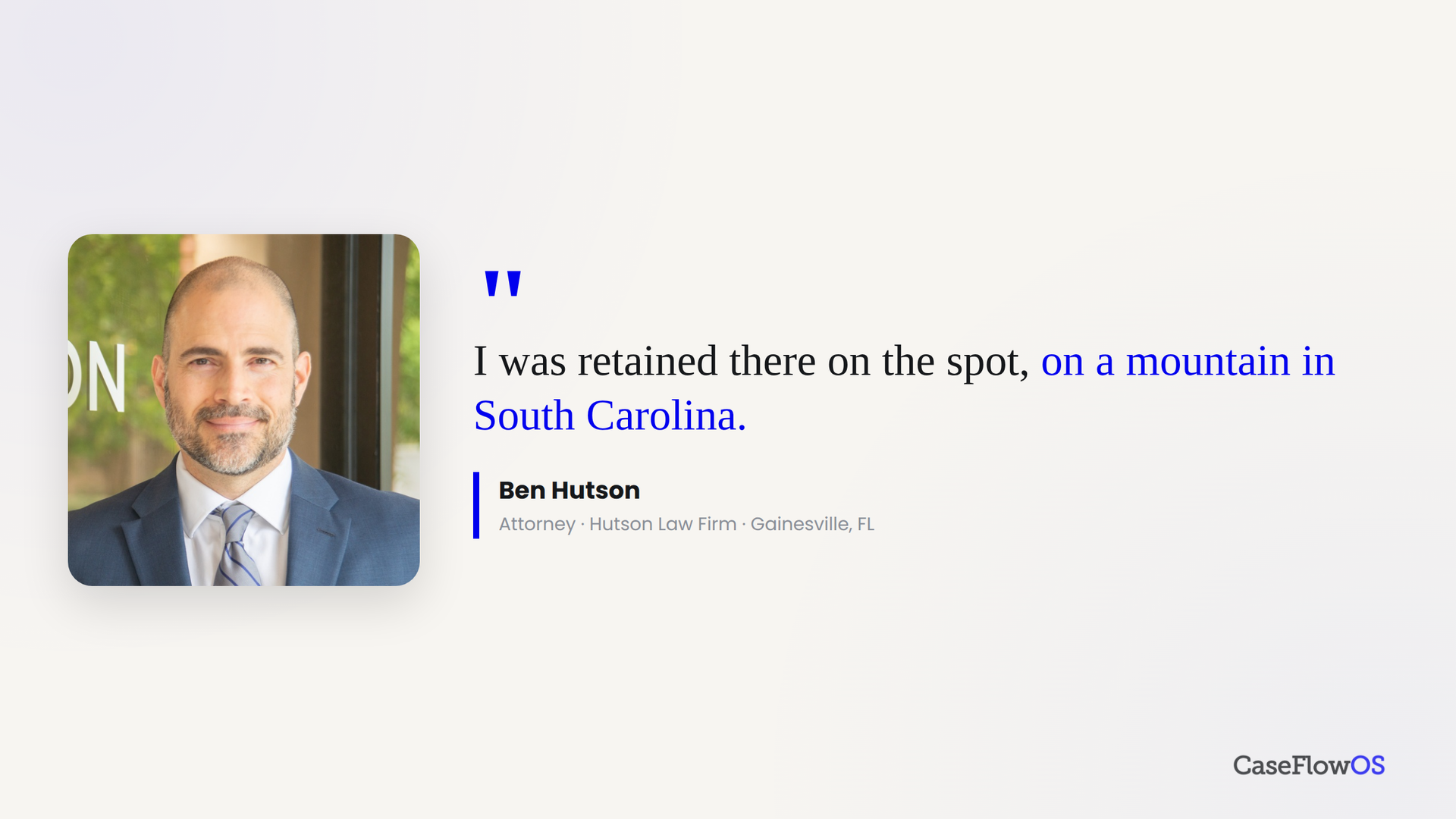
That is the entire argument for fixing intake, in one story. The marketing worked. The call came in. And because something answered it, qualified it, and booked it, the case got signed, from a trailhead, with no receptionist and no attorney at a desk.
What it cost
The two questions he had going in are the two questions every attorney has: "How much is this going to cost me, and what's going to be my rate of return on that? Are there going to be some sort of binding contract?"
What he found: "The money that I'm spending, not only is it less than I would be paying a human being to do that job for me, it also does it in a more effective and efficient way."
And on the outcome: "I honestly right now I don't know how I'd exist without it."
The four pillars of law firm marketing that actually works
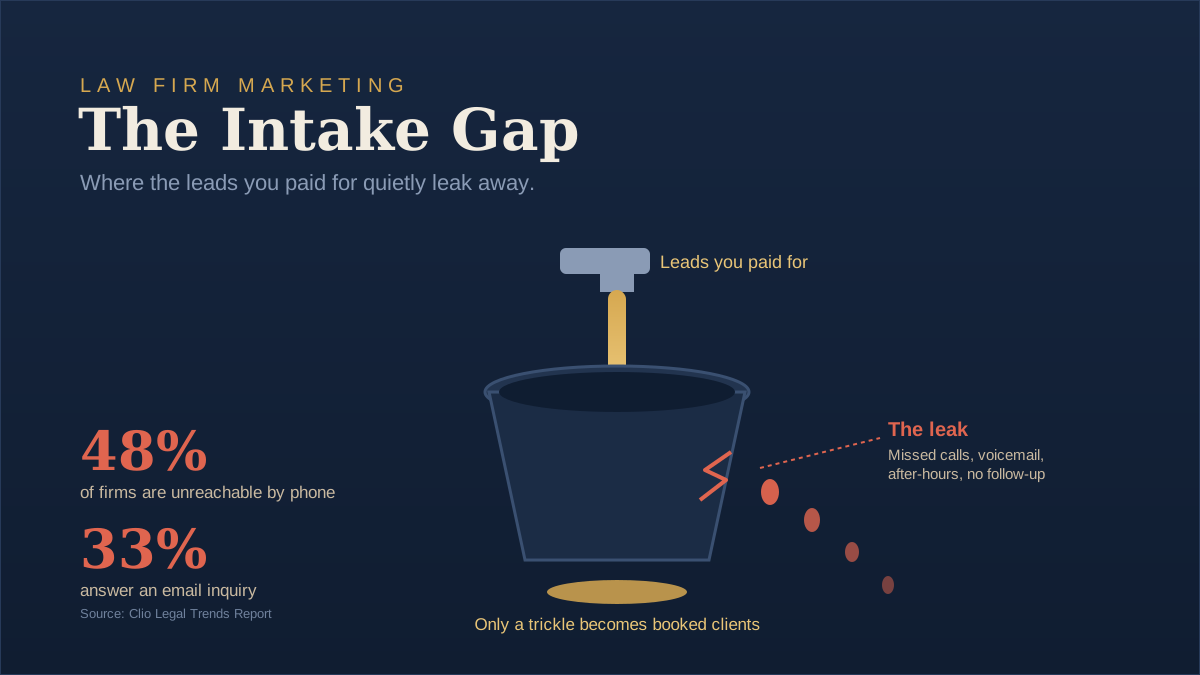
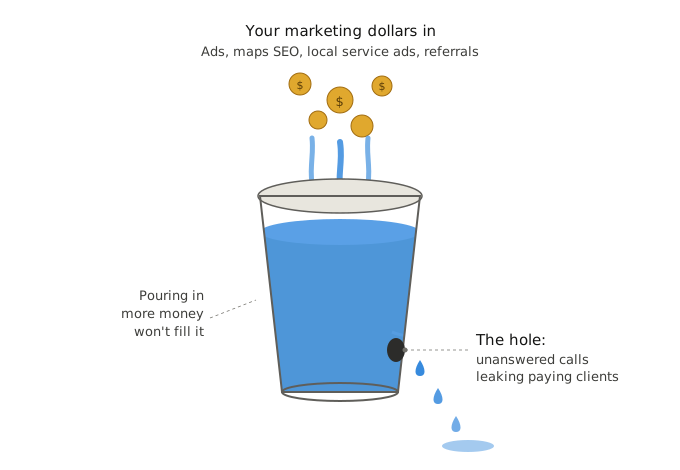
Ben's story is not an argument against marketing. He still runs ads. It is an argument that marketing without intake is a bucket with a hole in it.
A complete law firm marketing system has four pillars, not three. Here is what each one does and where most firms fall short.
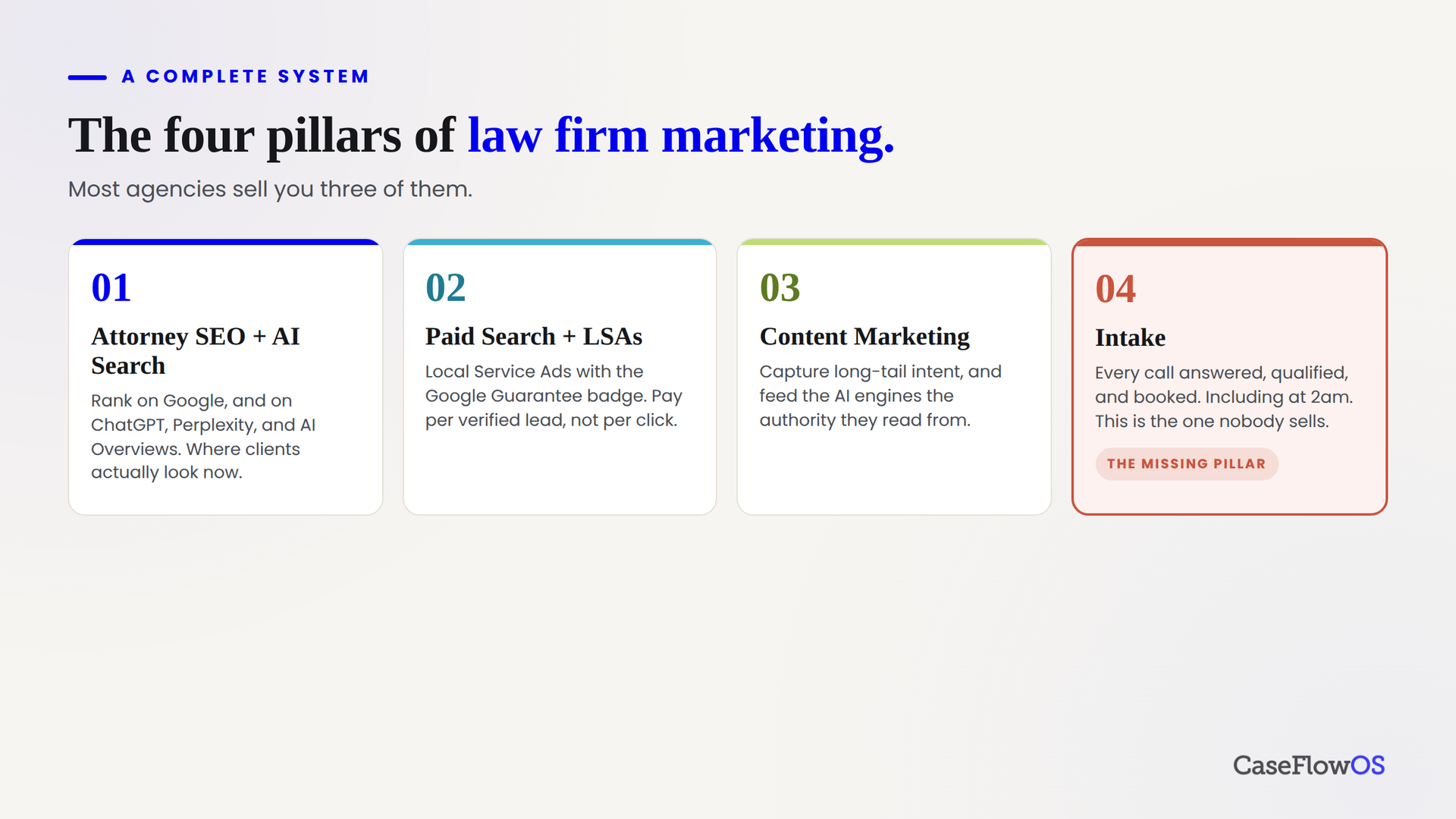
Pillar 1: Attorney SEO and AI search visibility
Traditional SEO still matters. But the search landscape shifted underneath most law firm websites, and most of them have not caught up.
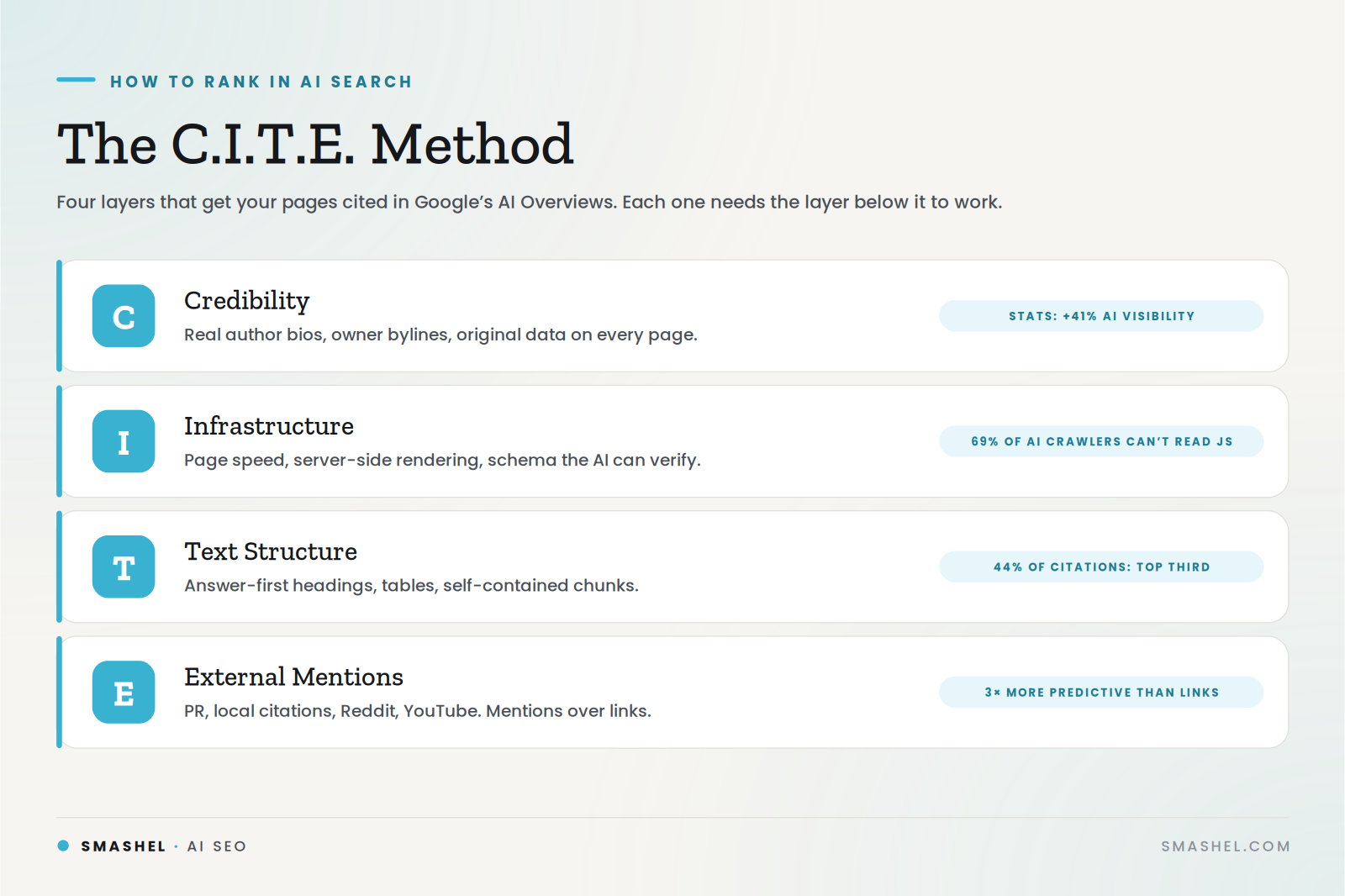
Your prospective clients are no longer only typing into Google. They are asking ChatGPT, Perplexity, and Google's AI Overviews. "Who is the best DUI lawyer in Gainesville?" now gets answered by an AI that synthesizes an answer from sources it trusts, and often the person never scrolls to a traditional result at all.
This means attorney SEO marketing now has two jobs. Classic SEO, meaning ranking in Google's organic results and the local map pack. And AI search visibility, meaning being the source the AI engines cite when someone asks about attorneys in your practice area and jurisdiction.
Firms that only optimized for 2018 Google are becoming invisible to a growing share of their market without realizing it. If you have not checked whether ChatGPT or Perplexity mentions your firm when asked about attorneys in your city, do that today. The answer is usually sobering.
Pillar 2: Paid search and Local Service Ads
Organic takes time. Law firm advertising buys you visibility now.
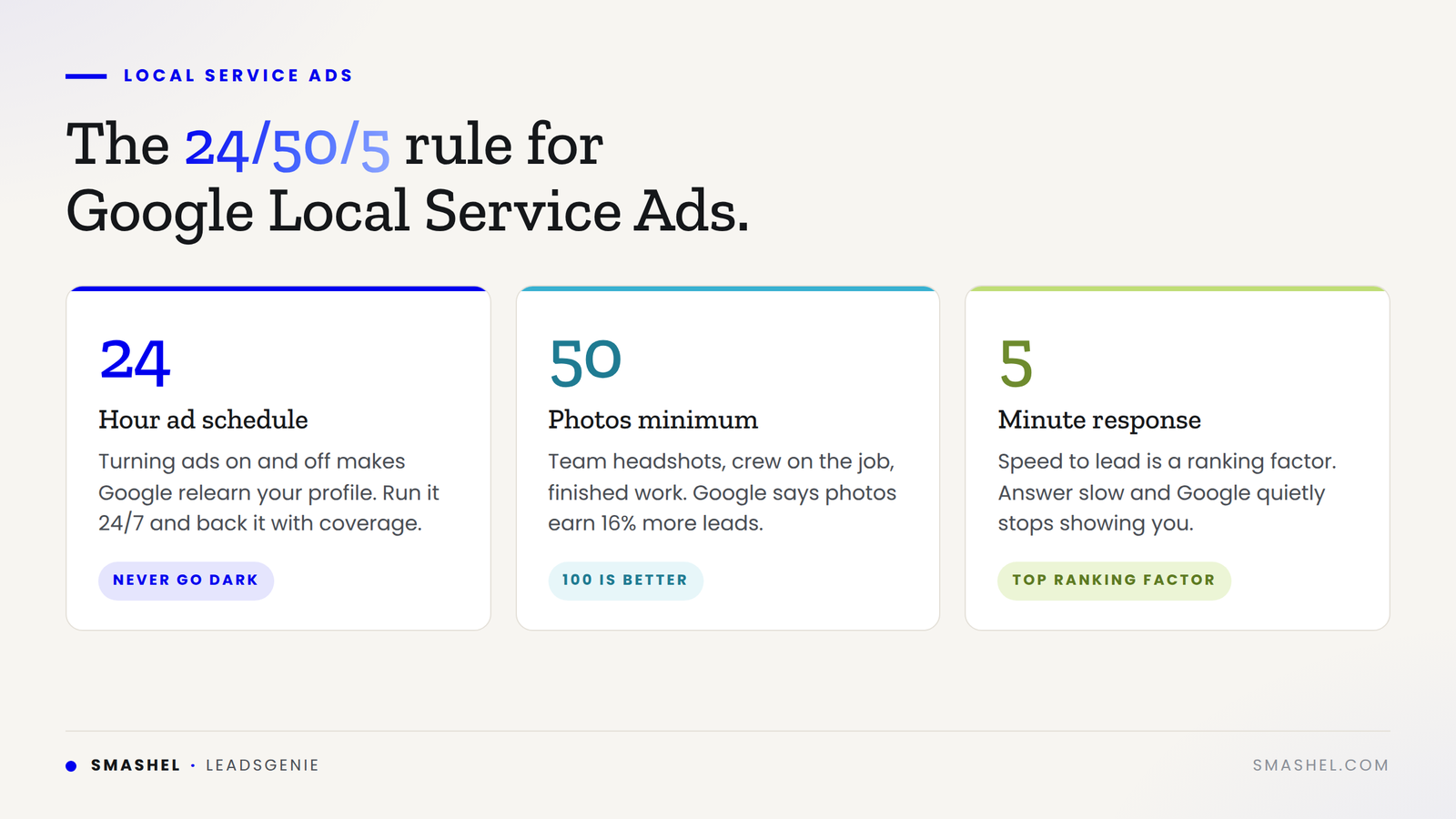
For legal, the highest-leverage placement is usually Local Service Ads with the Google Guarantee badge. They sit above traditional search ads, they carry a trust signal most competitors do not have, and you pay per verified lead rather than per click.
Standard Google Ads still have a role, particularly for practice areas and long-tail queries LSAs do not cover well.
The important framing: your media budget is paid to Google, not to your agency. It is the fuel, not the engine. Realistic starting budgets vary widely by practice area, with personal injury requiring the most and family law the least, and major metros running considerably higher than smaller markets.
Pillar 3: Content marketing for law firms
Content marketing for law firms is not about publishing generic blog posts nobody reads. It has two real jobs.
First, it captures long-tail search intent. Someone searching "what happens if I refuse a breathalyzer in Florida" is not ready to hire yet, but they are exactly the person who will need a DUI attorney in the next 72 hours. Answering that question well puts you in the room before your competitors know the case exists.
Second, and increasingly important: content is what AI engines read. When ChatGPT decides which attorneys to mention, it draws on the substance and authority of what you have published. Thin content means you are invisible to the AI layer.
Pillar 4: Intake, the pillar almost nobody sells
This is the one Ben fixed, and it is the one that makes the other three worth paying for.
Intake means every inquiry gets answered fast, gets qualified against your actual criteria, and gets booked onto your calendar. Consistently. Including at 2am.
You have three options.
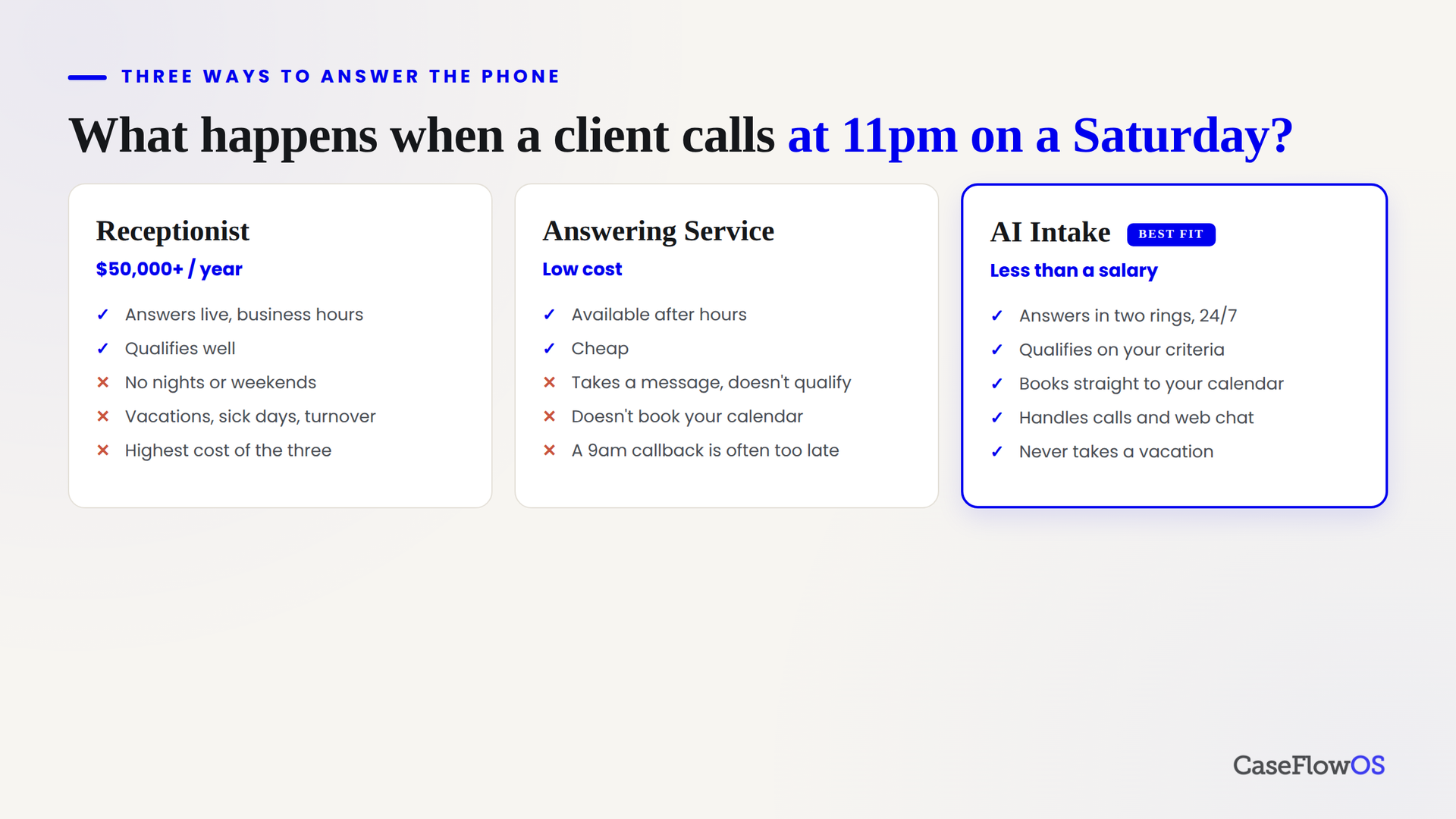
A full-time receptionist. Effective during business hours. Costs a salary plus benefits, typically $50,000 or more a year fully loaded. Does not cover nights, weekends, holidays, or vacations. And as Ben found out, they eventually leave.
A traditional answering service. Cheaper and available after hours, but most simply take a message. They do not qualify against your practice areas and jurisdiction, and they do not book on your calendar. A message at 11pm that you return at 9am has usually already lost the case.
AI intake. Answers immediately, day or night. Qualifies against criteria you define. Books directly onto your calendar. Handles calls and web chat with the same intelligence. Costs less than a salary. This is the category variously searched as an AI receptionist, a virtual receptionist for law firms, or legal intake software, and it has gotten dramatically better in the last two years.
How much should a law firm spend on marketing?
The common benchmark is 2% to 10% of gross revenue, with growth-stage firms at the higher end and established firms with strong referral flow at the lower end.
But the percentage is the wrong place to start. Start with unit economics instead.
- What is a signed case worth to you? Use your real average, not your best case.
- What is your consultation-to-signed-case rate? If you sign one in three, then three qualified consultations equals one case.
- What can you afford to pay for a qualified consultation? If a signed case is worth $10,000 and you sign one in three consultations, each consultation is worth roughly $3,300 in expected value.
Now you have a real ceiling. If your total marketing spend divided by your qualified consultations comes in well under that number, you should be spending more, not less.
Most firms never run this math, which is why marketing budgets get set by anxiety instead of arithmetic.
How to measure law firm marketing ROI
Track these six numbers. If you cannot produce them today, that is your first project.
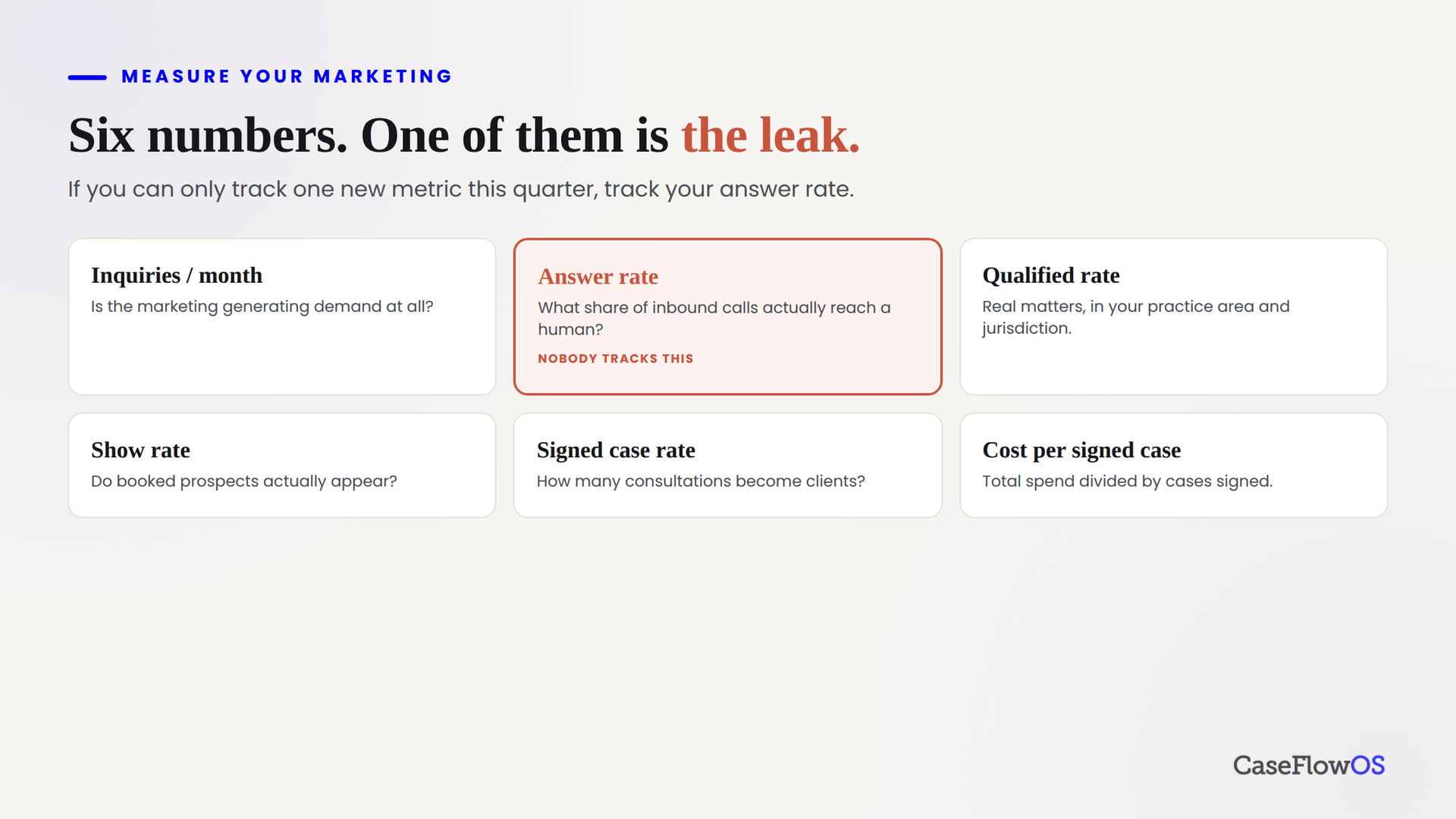
- Inquiries per month. Is the marketing generating demand at all?
- Answer rate. What percentage of calls are actually answered live?
- Qualified consultation rate. How many inquiries are real, in-jurisdiction, in-practice-area matters?
- Consultation show rate. Are booked prospects actually appearing?
- Signed case rate. How many consultations become clients?
- Cost per signed case. Total marketing spend divided by signed cases.
The answer rate is the one nobody tracks, and it is usually the leak.
Pull your phone records for last month. Count inbound calls. Count how many were answered live. Most small firms who do this exercise for the first time discover that somewhere between a third and half of their inbound calls never reached a human. Every one of those was a marketing dollar spent and thrown away.
What small law firms should look for in a marketing partner
Ben's concerns are the right concerns. Use them as your checklist.
- No long-term lock-in. He specifically valued that there was no binding, evergreen, auto-renewing agreement of the kind many agencies use to make cancellation painful.
- Transparent pricing. He wanted to know exactly what he would be charged. If an agency will not publish or plainly state its pricing, ask why.
- Real accountability for outcomes. Ask what happens if the work does not produce results. A partner confident in their system will put a specific, measurable commitment in writing.
- They handle intake, not just traffic. If a prospective agency's scope ends when the phone rings, they are selling you three quarters of a solution and leaving the most expensive quarter to you.
- They fit how you actually practice. Ben does not want to compete with the biggest firms in the state. He wants a limited number of well-fit clients. A good partner builds toward the practice you want, not the practice they think you should want.
Frequently asked questions about law firm marketing
How do I market a small law firm on a limited budget?
Start where the leak is. Fixing intake, so that every call that already comes in gets answered and booked, usually produces more signed cases per dollar than adding new traffic. Then invest in local SEO and Local Service Ads, which have the highest intent per dollar in legal.
How much do law firms spend on marketing?
Typically 2% to 10% of gross revenue. Growth-stage and personal injury firms trend higher. The more useful question is what a qualified consultation is worth to you, and whether your current cost per consultation is below that.
Can AI help with law firm intake?
Yes, and this is the single biggest change in law firm marketing in the last two years. Modern AI intake systems answer within seconds, qualify callers against your practice areas, jurisdiction, and retainer criteria, and book consultations directly onto your calendar, 24 hours a day. Ben Hutson replaced a ten-year human assistant with one and describes it as costing less while performing more effectively.
How do I improve my law firm's intake conversion rate?
Three levers, in order of impact. First, answer speed: the first attorney to respond usually signs the case. Second, qualification: screen for practice area, jurisdiction, and retainer capacity so your calendar fills with real matters. Third, booking friction: get the consultation on the calendar during the first contact, not after a callback.
What are the marketing limitations for law firms?
State bar advertising rules govern attorney marketing and vary by jurisdiction. Common constraints include restrictions on guarantees of outcomes, testimonials, comparative claims, and required disclaimers. Always review your state bar's advertising rules, and work with a compliance-aware partner.
How do I measure ROI on law firm marketing spend?
Track inquiries, answer rate, qualified consultations, show rate, signed cases, and cost per signed case. If you can only track one new number this quarter, track your answer rate.
How do I market a personal injury law firm?
Personal injury is the most competitive and most expensive legal vertical, with the highest cost per click of any practice area. Speed to lead is decisive, because PI claimants typically call several firms and retain whoever responds first and most credibly. That makes intake and answer speed more important in PI than in any other practice area.
The takeaway
Marketing gets the phone to ring. Intake decides whether the ring becomes a case.
Ben Hutson did not fix his firm by outspending the big players. He fixed it by making sure that every qualified caller who reached his firm got answered, screened, and booked, whether he was at his desk, in court, or halfway up a mountain in South Carolina.
If you want to know where your own cases are leaking, start with one number: how many calls did your firm miss last month?
Ready to find your leak?
CaseFlowOS is the AI case acquisition system we built for law firms. Google Ads, Local Service Ads, and AI agents that answer every call in two rings, qualify the caller, and book the consultation on your calendar. 24/7.
Our guarantee: 10 qualified consultations in your first 90 days, or we work for free until you hit it.