Law Firm Marketing: How to Stop Losing Clients to Missed Calls

Albert Quintero • June 6, 2026

You probably do not have a traffic problem. You have an intake problem, and it is quietly draining the leads you already paid for.

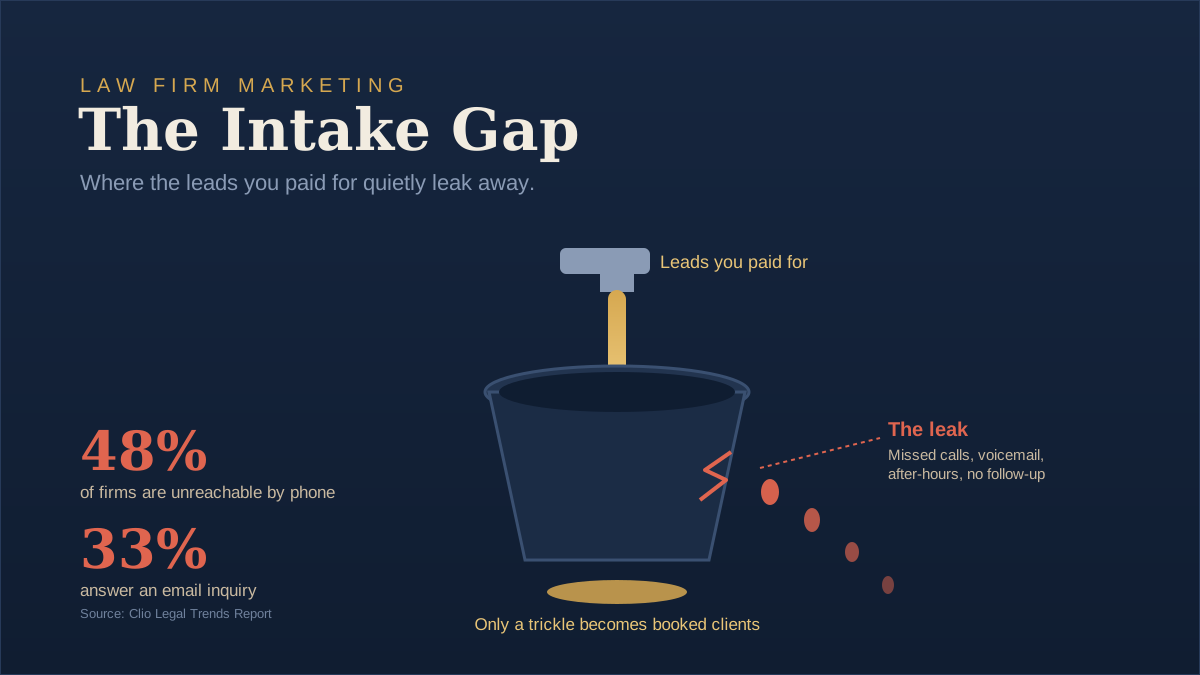
Infographic of a marketing funnel titled “The Intake Gap” on a dark blue background with orange stats and a bucket diagram

You can spend a fortune on law firm marketing and still watch clients walk straight to the firm down the street. Not because your ads are bad. Not because your reviews are weak. But because of something quieter and far more expensive, happening between the moment a lead reaches out and the moment your firm actually answers.


A few months ago, an attorney pulled me aside at my local BNI meeting. He looked exhausted. He had just burned through his third receptionist in under two years, and he asked the question most lawyers are too proud to ask: could a bot do this instead?


Most people would have called that crazy. But his receptionist problem was not really a receptionist problem. It was the same thing quietly bleeding money out of almost every law firm in America.


By the end of this article, you will know exactly what that gap is, why it is killing your marketing budget, and the embarrassingly simple fix this "lazy" attorney used to get ahead of everyone else in his town.

The Real Problem Is the Intake Gap, Not Your Marketing


When I asked him what kept happening with the receptionists, the story was always the same. One quit. One got sick. One was great, but she only worked nine to five. So every call that came in at 7pm, or on a Saturday, or while she was already on another line, went straight to voicemail.


Here is the part that made him wince. He had no idea how many of those callers ever called back.


The honest answer is most of them did not. Legal clients do not wait. When someone gets arrested, gets in a wreck, or gets served papers, they are scared and they want help right now. If you do not pick up, they do not leave a polite message and wait by the phone. They call the next lawyer on the list.


So this attorney did not have a hiring problem. He had a structural hole in his business. Every lead he generated had to squeeze through one tired human being who could only be in one place, on one call, during one slice of the week.


That hole has a name. I call it the Intake Gap: the space between a client raising their hand and your firm actually catching them. Once he saw it, he could not unsee it.


Quick context on why he came to me. My name is Albert, and I have run a digital marketing agency in Florida for over 13 years, almost all of it built on Google: SEO, Maps SEO, Google Ads, and Local Service Ads. Getting the phone to ring is what I do. But a few years back I realized getting leads is only half the job. If they do not get answered and booked, they are gone.

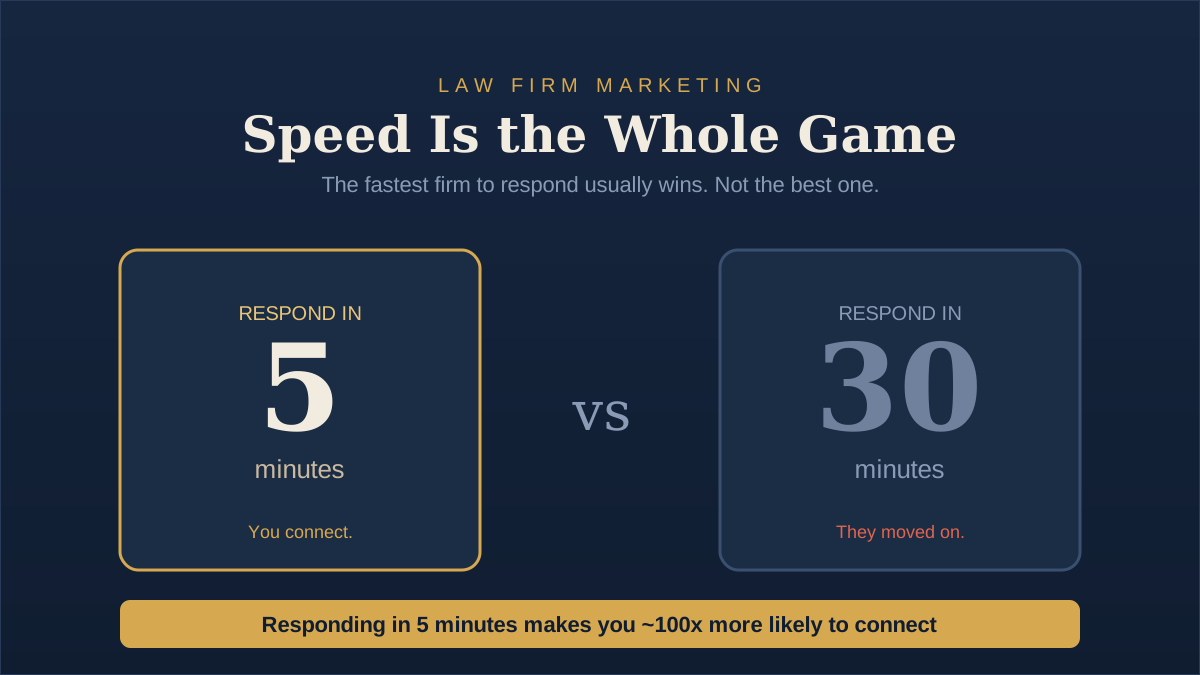
Dark blue law firm marketing graphic comparing 5-minute and 30-minute response times, with “VS” in between

Why the Intake Gap Is Everyone's Problem


His story should make you a little nervous, because it is not a him problem. It is an everybody problem.


Start with the receptionist role itself:


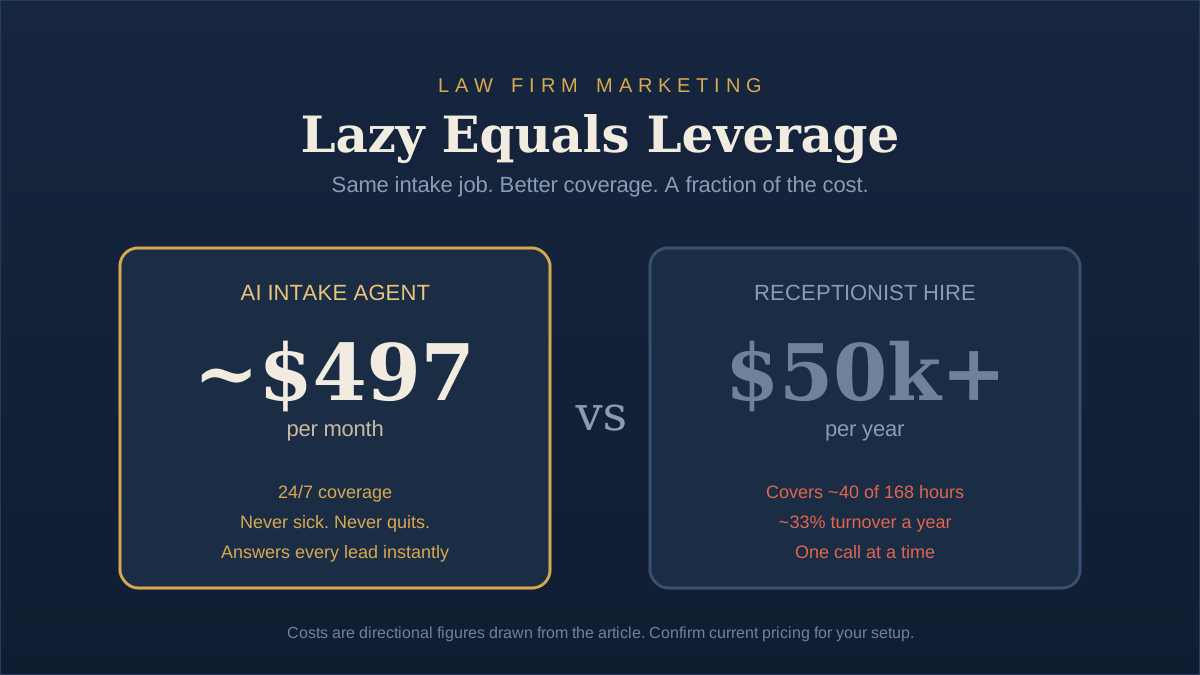
  • Turnover runs around 33% a year.
  • Replacing one can cost anywhere from half to twice their salary once you count hiring and training.
  • An all-in receptionist runs you north of $50,000 a year.


Then there is coverage. One person covers about 40 of the 168 hours in a week, one call at a time. They cannot answer two phones at once, and they definitely cannot answer at 9pm.


And the leak is everywhere. A secret-shopper study of real law firms (Clio's Legal Trends Report) found that:


  • Only about 40% answered the phone.
  • Just 33% responded to an email inquiry.
  • Nearly half (48%) were essentially unreachable by phone.


Think about that. Whatever those firms spend getting the phone to ring, roughly half of it leaks back out before anyone ever talks to a client.


Why the Gap Is So Expensive in Legal


Here is what makes that leak so brutal in this business specifically: legal clients do not give you a second chance.


Consumer research from Martindale-Avvo shows that almost 8 in 10 people who hire a lawyer contact more than one first. Only about 11% hire the very first attorney they reach, and most move on if they do not hear back within a day or two. The firm that answers first usually wins. Not the best firm. The fastest one.


And the speed math is wild. A classic lead-response study (general sales research, not legal-specific, so take it as directional) found that reaching out within five minutes instead of thirty made you roughly 100 times more likely to actually connect with that lead. A hundred times, off of twenty-five minutes.


Now layer in money. Firms pay real cash for every lead, often well over $100 in competitive areas and more for personal injury. So here is the truth most people miss:

"You do not have a traffic problem. You have an intake problem."

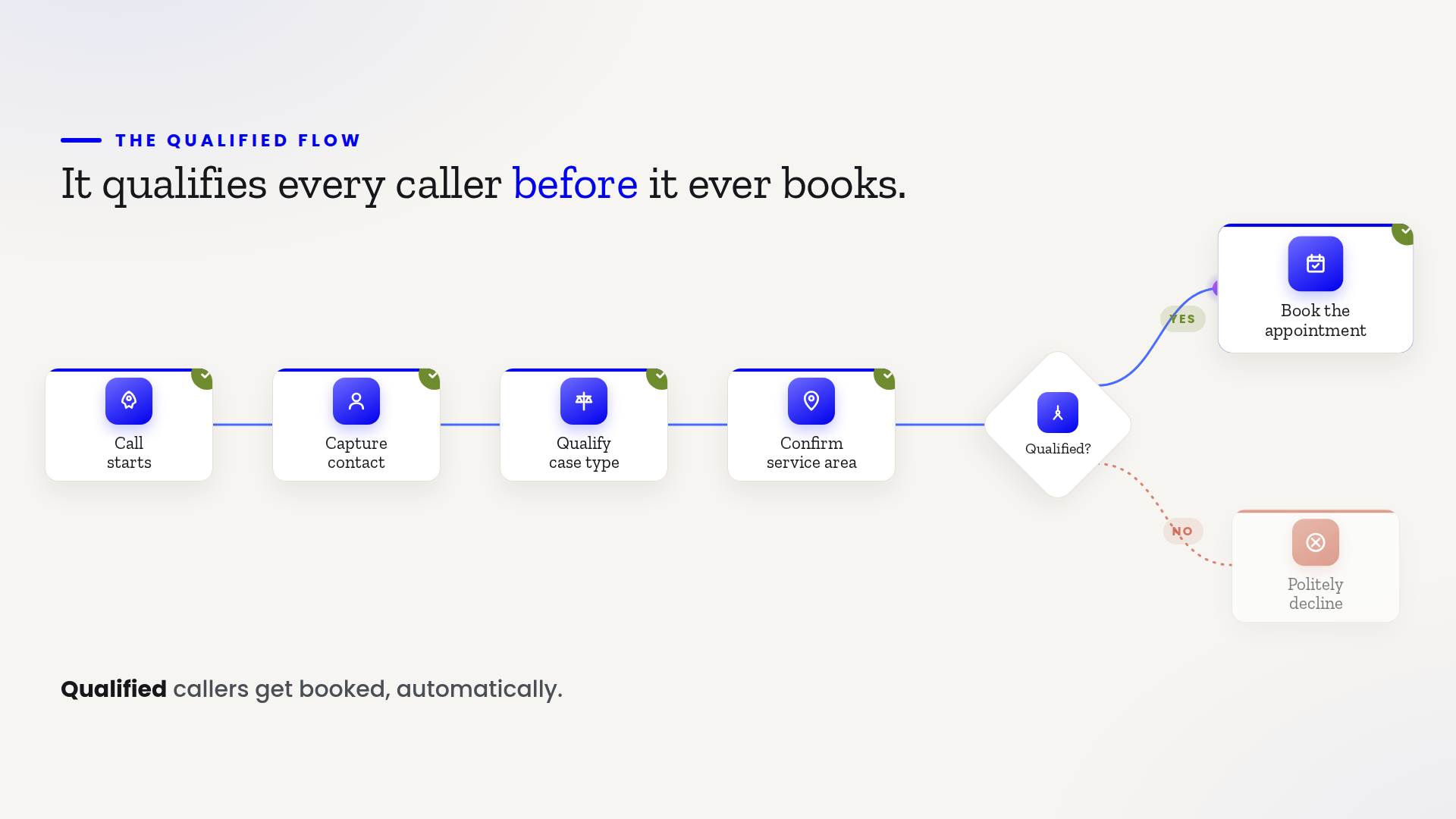
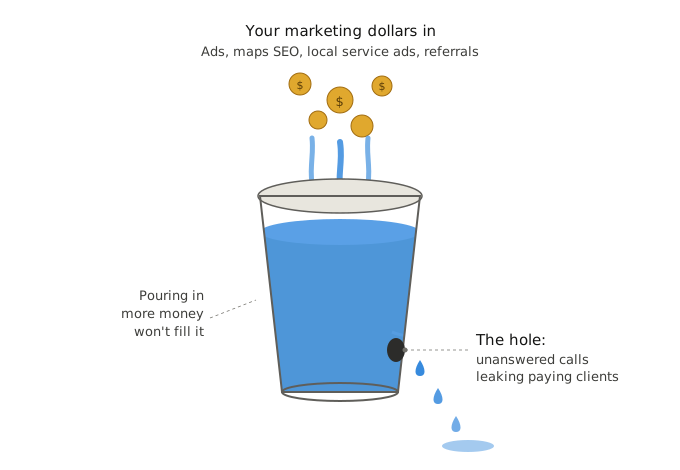
Buying more leads to pour into a broken intake is the most expensive mistake in law firm marketing. It is like filling a leaky bucket with the tap wide open. The water was never the issue. The hole is. And no, the fix is not hiring more people.

Dark blue law firm marketing graphic comparing $497 monthly vs $50k+ per month packages.

Lazy Equals Leverage: The AI Fix


Here is where lazy becomes a superpower. Being lazy the smart way is not about doing nothing. It is leverage. You take the repetitive work that eats your day and hand it to something that never gets tired, then you spend your time on the work only a lawyer can do.


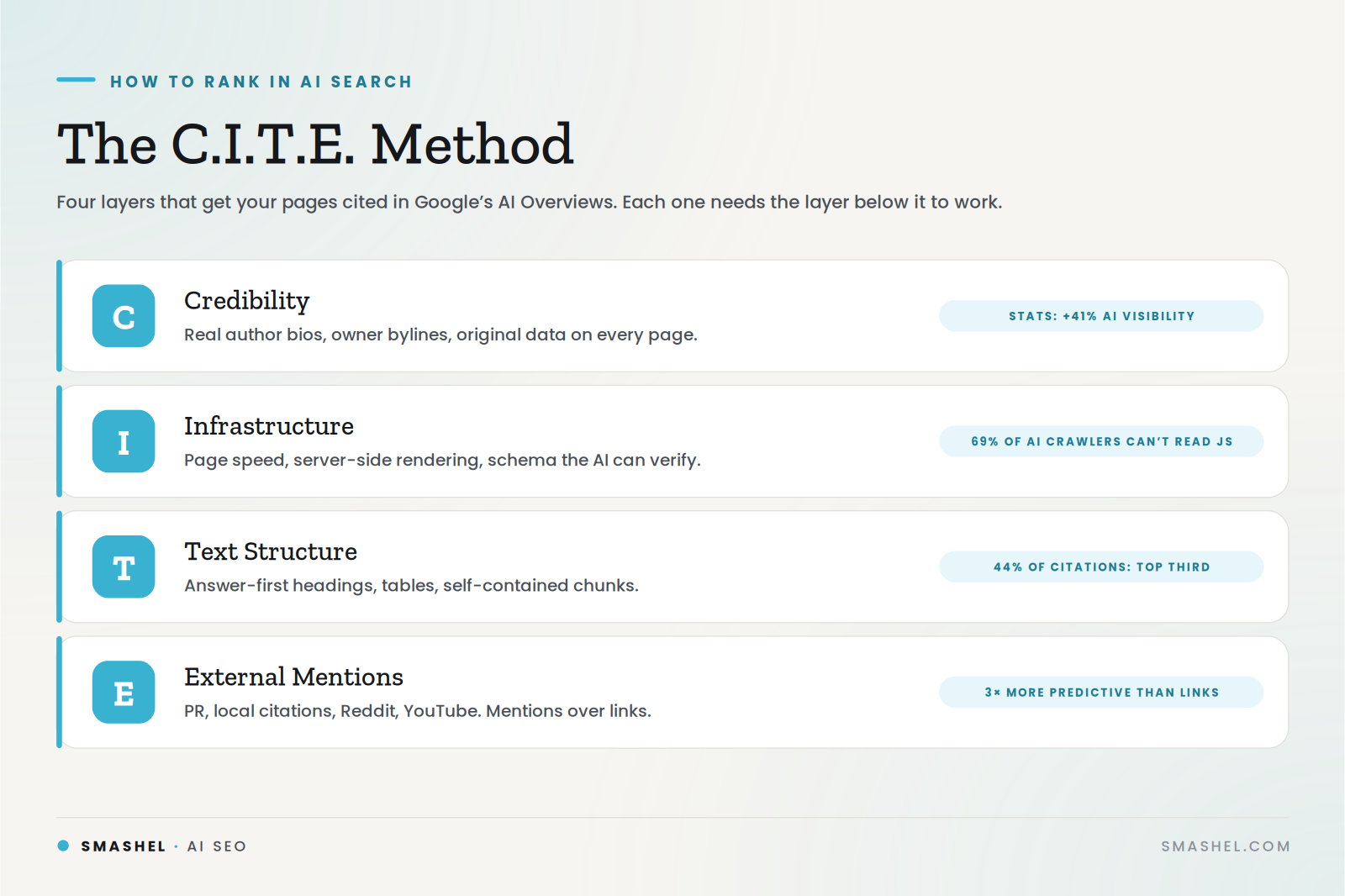
So we built him a bot. The moment a lead comes in by call, text, or web form, it:

  1. Answers instantly, day or night.
  2. Asks the qualifying questions.
  3. Runs a basic conflict check.
  4. Books the consultation straight onto his calendar.
  5. Follows up if the lead goes quiet.


It is never sick. It never quits. It is never already on another line.


The Tools We Actually Use


You do not need to build this from scratch. We pair three platforms:

  • Retell AI handles the voice side. It is the conversational layer that picks up calls and talks to leads naturally, so a caller at 2am gets a real conversation instead of a voicemail beep.
  • CloseBot handles the text side. It is a flow-based messaging AI that works the lead over SMS and web chat, asking the qualifying questions, running a basic conflict check, and guiding them to book, all through a conversation flow you control. It is what catches the people who would rather text than call.
  • GoHighLevel (GHL) handles everything around the call: capturing the lead, scheduling the consultation, running automated text and email follow-up, and keeping it all in one CRM.


Together they close the Intake Gap end to end, from first hello to booked appointment to follow-up.


This is not some tiny edge case either. Research from Clio estimates that close to three-quarters of a law firm's billable tasks are exposed to this kind of automation. So the payoff is not just saving money. It is concentration: less time on intake busywork, more time on the high-value work that actually pays.


Does It Actually Work? The Proof and the Timing


It does, and the timing right now is the best part.


Lawyer AI adoption reportedly jumped from about 19% in 2023 to nearly 80% in 2024 (Clio). More conservative independent surveys, like the ABA's, put real AI use closer to 30% of attorney offices. That gap is exactly why I love it. It means the shift is real, and there is still a head start sitting there for whoever in your town moves first.

And no, your clients will not hate it. Around 70% of clients say they are fine with, or even prefer, a firm that uses AI, as long as their problem gets handled fast.


The results back it up. As reported in vendor case studies:

  • One firm took inquiry-to-case conversion from 10% up to 35%.
  • A solo attorney reported converting close to half his leads into clients, and said he could not imagine running his practice without it.


Then there is the number that ends the argument: a setup like this runs around $497 a month. Compare that to $50,000 a year for a hire who covers a quarter of the week and eventually quits anyway. Same job. Better coverage. A fraction of the cost. That is lazy equals leverage in one line.


One Compliance Note You Cannot Skip


Before any lawyer panics, yes, you handle the obvious. The bot clearly states it is not an attorney. It does not give legal advice. You keep human oversight, and it follows your state bar rules.


Accuracy is the number one thing lawyers worry about with AI, so you build those guardrails in from day one. Done right, that is not a liability. It is a trust signal.


How to Close Your Intake Gap This Week

You do not need a six-month project to start catching the leads you are already paying for. Work down this list:

  1. Audit your answer rate. Call your own firm after hours and on a Saturday. See what a real client experiences.
  2. Track first-response time. If it is longer than five minutes, that is your single highest-leverage fix.
  3. Stop buying more leads until intake works. Plugging the hole beats widening the tap.
  4. Deploy an always-on intake layer (a voice AI agent plus a CRM that books and follows up) so no call goes to voicemail.
  5. Set your guardrails first, including the AI disclosure, no legal advice, and human oversight.


If your firm already answers more than 90% of calls and responds in minutes, you do not need a rescue. In that case, use the bot for overflow and after-hours scaling, and put your energy into lead volume instead.


Watch the Full Story


I broke down the whole story in the video above, including how this attorney plugged his Intake Gap without hiring a single new person. If you want to see the exact setup in action, give it a watch, then run the five-step audit on your own firm this week.

  • What is the Intake Gap in law firm marketing?

    The Intake Gap is the space between a potential client reaching out and your firm actually catching, qualifying, and booking them. Most marketing budgets pour leads into the top of this gap, then lose a big share before anyone ever talks to the client.

  • Will an AI receptionist replace my front desk staff?

    Not necessarily. It handles repetitive intake work like answering, qualifying, conflict checks, scheduling, and follow-up, which frees your people for higher-value tasks. Many firms use it for after-hours and overflow rather than as a full replacement.


  • Is using AI for legal client intake allowed under bar rules?

    It can be, as long as the bot discloses it is not an attorney, does not give legal advice, and operates under human oversight in line with your state bar rules. Accuracy and guardrails are the things to get right from day one.


  • How fast do I really need to respond to legal leads?

    As fast as possible. Research shows most legal clients contact more than one attorney and move on if they do not hear back within a day or two, and responding within five minutes makes you dramatically more likely to connect.


  • How much does an AI intake setup cost compared to hiring?

    A setup like this runs roughly $497 a month, versus more than $50,000 a year for an in-person receptionist who only covers part of the week. The cost difference is a large part of why the math works.


Diagram of how to stop missing calls in a business with an after-hours AI receptionist workflow
IMAG
By Albert Quintero May 31, 2026
Stop missing calls in your business and losing paying clients. See how AI receptionists answer every call 24/7 and book leads automatically.